Bild:Translational motion.gif
Beschrieven
| Beschrievung |
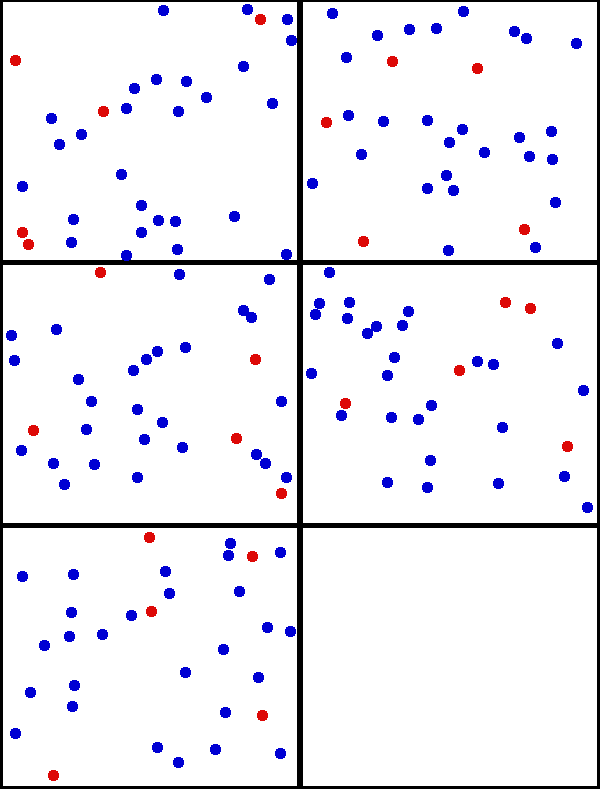
English: Motion of gas molecules.
The randomized thermal vibrations of fundamental particles such as atoms and molecules—gives a substance its “kinetic temperature.” Here, the size of helium atoms relative to their spacing is shown to scale under 1950 atmospheres of pressure. These room-temperature atoms have a certain, average speed (slowed down here two trillion fold). At any given instant however, a particular helium atom may be moving much faster than average while another may be nearly motionless. The rebound kinetics of elastic collisions are accurately modeled here. If the velocities over time are plotted on a histogram, a Maxwell-Boltzmann distribution curve will be generated. Five atoms are colored red to facilitate following their motions. Note that whereas the relative size, spacing, and scaled velocity of the atoms shown here accurately represent room-temperature helium atoms at a pressure of 1950 atmospheres, this is a two-dimensional scientific model; the atoms of gases in the real world aren’t constrained to moving in two dimensions in windows precisely one atom thick. If reality worked like this animation, there would be zero pressure on the two faces of the box bounding the Z-axis. The value of 1950 atmospheres is that which would be achieved if room-temperature helium atoms had the same inter-atomic separation in 3-D as they have in this 2-D animation.Español: Animación mostrando la agitación térmica de un gas. Cinco partículas han sido coloreadas de rojo para facilitar el seguimiento de sus movimientos.
Русский: Хаотическое тепловое движение на плоскости частиц газа таких как атомы и молекулы
Français : Animation montrant l'agitation thermique affectant les molécules d'un gaz. Cinq d'entre elles sont colorées à seule fin de suivre plus facilement leur mouvement individuel. |
| Datum/Tiet | |
| Born | Egen Wark |
| Autor | A. Greg (Greg L op de Wikipedia op Engelsch) |
| Annere Versionen |
Single frame (for thumbnail purposes) Von disse Datei afleidt Warken: |
|


Lizenz

|
Diese Abbildung einfacher Geometrie ist gemeinfrei („public domain“), weil sie ausschließlich Allgemeingut enthält und die nötige Schöpfungshöhe nicht erreicht. |  |
Datei-Historie
Klick op de Tiet, dat du de Datei ankieken kannst, so as se do utseeg.
| Datum/Tiet | Duumnagelbild | Grött | Bruker | Kommentoor | |
|---|---|---|---|---|---|
| aktuell | 04:31, 28. Mär 2008 | | 300 × 263 (398 KB) | wikimediacommons>Greg A L |
Dateibruuk
Disse Sied bruukt dit Bild:
